
What if the greatest risk to your real estate legacy isn't the IRS, but the ticking clock of a 45-day identification window in a market with only 1.4 months of inventory? You likely recognize that securing 1031 exchange properties Michigan offers is the most effective way to defer capital gains and the state's 4.25% income tax. However, the complexity of "like-kind" requirements and the fear of a failed exchange can make the process feel incredibly high-stakes. We view these transitions as significant personal milestones that deserve a methodical approach, expert insight, and localized reliability.
This guide provides the strategic framework you need to master 2026 exchanges and build a lasting legacy of West Michigan wealth. You'll discover how to navigate strict federal deadlines, identify higher-yield assets in a tight market, and ensure a seamless transition between properties. We will examine current Grand Rapids inventory data, breakdown the latest tax regulations, and outline a clear path to achieving full tax deferral with confidence, security, and precision.
Key Takeaways
- Defer federal and state capital gains taxes to keep your investment capital working for you rather than the IRS.
- Broaden your acquisition strategy by learning which diverse property types in West Michigan qualify as "like-kind" under Section 1031.
- Secure 1031 exchange properties Michigan investors rely on by following a precise, step-by-step timeline for identification and acquisition.
- Target resilient neighborhoods like Ada, Cascade, and Forest Hills to ensure your replacement property offers both stability and long-term yield.
- Orchestrate a seamless transition by coordinating your qualified intermediary, tax professionals, and consultants through a unified, strategic plan.
Understanding 1031 Exchanges in the Michigan Real Estate Landscape
A successful real estate investment isn't just about the initial acquisition; it's about the intentional evolution of your portfolio over time. For many, the Internal Revenue Code section 1031 serves as the bridge between current assets and a future legacy. This provision allows you to sell a property held for investment and reinvest the proceeds into a new property of "like-kind" while deferring all capital gains taxes. In 2026, this strategy has become essential for those managing 1031 exchange properties Michigan offers, specifically as investors look to pivot toward high-growth corridors in West Michigan.
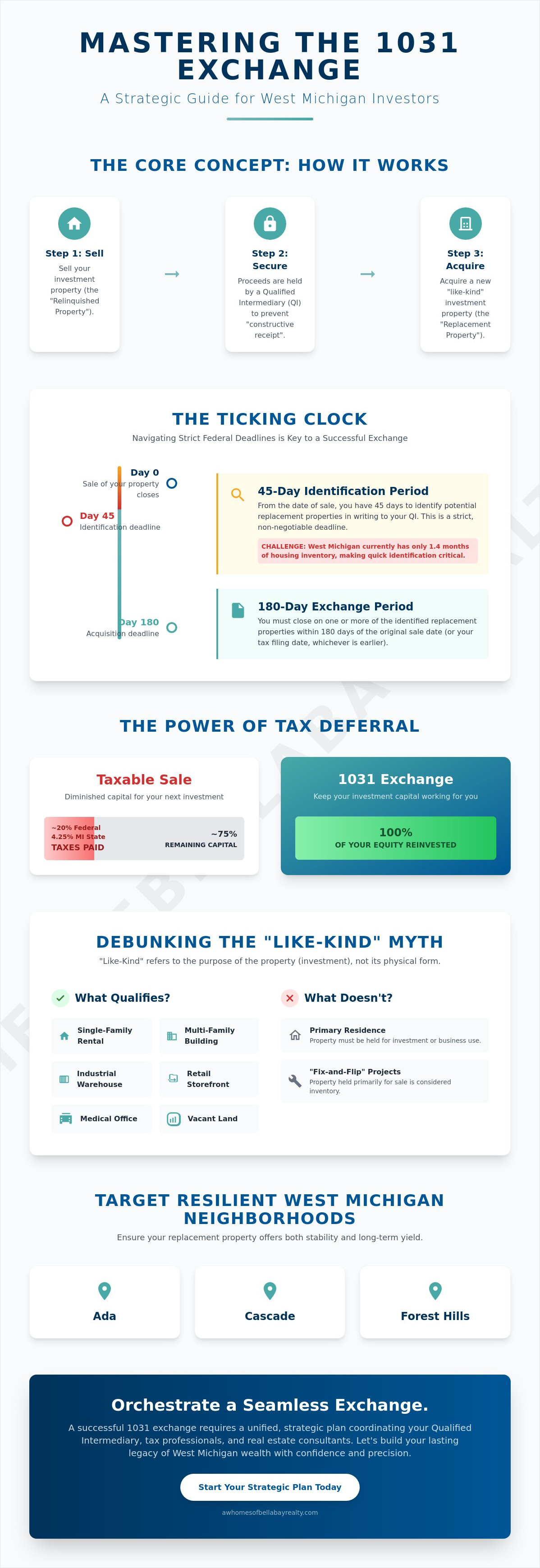
The primary benefit is the preservation of capital. By deferring the federal capital gains tax and the 4.25% Michigan individual income tax, you keep your entire equity working for you. This transition requires a methodical approach and a mandatory partner known as a Qualified Intermediary (QI). The QI is an independent third party who holds your sale proceeds to prevent "constructive receipt." If you touch the funds yourself, the IRS views the sale as a taxable event, immediately triggering liabilities that could diminish your purchasing power by 20% or more. We view this process as a strategic milestone that demands expert navigation, precise timing, and unhurried execution.
The Core Mechanics of Tax Deferral
An exchange is not a simple "sell and buy" transaction; it's a structured swap. To qualify, the property must be held for productive use in a trade, a business, or for investment. This requirement applies to residential rentals, industrial spaces, and vacant land across the Greater Grand Rapids area. For business entities, it's vital to coordinate with a consultant who understands the Michigan Corporate Income Tax (CIT) treatment. This ensures the entity selling the property is the same entity acquiring the replacement, maintaining a seamless tax-exempt status throughout the transition.
Why Michigan Investors Prioritize 1031 Exchanges
Strategic investors view the 1031 exchange as a tool for wealth accumulation, portfolio diversification, and legacy planning. By deferring taxes, you benefit from compounding growth on money that would otherwise be paid to the government. This process allows you to:
- Upgrade Assets: Transition from high-maintenance properties to higher-yield residential or investment holdings.
- Expand Footprint: Move your equity into high-growth West Michigan neighborhoods like Ada, Cascade, or Forest Hills.
- Preserve Wealth: Utilize the "step-up in basis" rule to protect the financial future of your heirs and eliminate deferred taxes over time.
Defining Like-Kind Properties: What Qualifies in West Michigan?
Identifying the right 1031 exchange properties Michigan offers begins with deconstructing a common myth: like-kind doesn't mean identical. Many investors feel anchored to their current asset class, believing a single-family rental must be replaced by another single-family home. In reality, the IRS definition is remarkably flexible. It focuses on the intent of the property rather than its physical form or grade. Understanding these 1031 exchange basics for investors is the first step toward a more intentional financial future. This flexibility allows you to pivot your strategy as your life stages and financial goals evolve.
To qualify for tax deferral, the property must be held for productive use in a trade, business, or for investment. This requirement excludes primary residences and "fix-and-flip" projects. The IRS views flips as inventory held for sale rather than long-term investment assets. However, almost any other real property in the Greater Grand Rapids area can be exchanged. You can move from a retail storefront to a residential rental, or from an industrial warehouse to a medical office. We provide the strategy, clarity, and localized insight needed to make these transitions seamless.
The Broad Scope of Like-Kind Assets
The beauty of the 1031 exchange lies in its ability to facilitate portfolio diversification. You might choose to exchange a single-family rental in Wyoming for a larger multi-unit building to increase your monthly cash flow. Exploring multi family homes for sale Grand Rapids provides a clear path toward scaling your wealth. Similarly, you could trade raw land in Caledonia for a luxury condo in East Grand Rapids. This move allows you to transition from non-income-producing land into a high-demand residential asset without immediate tax consequences.
Michigan-Specific Property Considerations
West Michigan offers unique opportunities that require specialized expertise. Vacation rentals in coastal communities or urban centers can qualify if they meet "Safe Harbor" rules, which generally require the property to be rented for at least 14 days a year with limited personal use. In Kent and Ottawa Counties, we often see transitions involving agricultural land. You can exchange farmland for commercial property or residential rentals as long as both are held for investment. Additionally, leasehold interests with 30 years or more remaining on the term are considered like-kind to fee-simple real estate. If you're unsure if your current asset qualifies for this process, our real estate investment consulting can provide the professional reassurance you need to move forward with confidence.
Navigating Michigan 1031 Exchange Rules and Critical Timelines
The transition from one investment to the next begins on "Day 0." This is the moment you close the sale of your relinquished property. From this second, the IRS clock starts ticking, and it does not stop for weekends, holidays, or market conditions. There are no extensions for these deadlines. We understand that this schedule can feel daunting, especially in a year where 1031 exchange properties Michigan investors are targeting are in high demand. Our role is to provide the steady, methodical guidance necessary to ensure your capital remains protected and your progress stays on track.
A Qualified Intermediary (QI) is your mandatory partner in this process. They hold the proceeds from your sale in a secure account to prevent "constructive receipt." If you take possession of the funds, even for a moment, the tax deferral is void. This partnership provides the emotional security of knowing your transaction is being handled with professional precision. By delegating the financial logistics to a QI, you can focus entirely on the strategic task of identifying your next asset within the first 45 days.
The 45-Day Identification Strategy
The 45-day window is the most critical phase of the exchange. In 2026, the Grand Rapids market faces a tight supply with only 1.4 months of inventory available. You cannot afford to start your search on Day 1. Instead, we recommend using a concierge real estate service to pre-scout potential replacements before your current property even hits the market. You'll typically follow one of two rules for identification:
- The Three-Property Rule: You may identify up to three properties of any value.
- The 200% Rule: You can identify any number of properties, provided their combined fair market value doesn't exceed 200% of the property you sold.
The 180-Day Closing Roadmap
Once your replacement properties are identified, you have until the 180th day to complete the acquisition. This period includes the time spent navigating the home closing process in Michigan, which requires coordination between lenders, inspectors, and title companies. It's vital to remember that the 180-day window runs concurrently with the 45-day identification period. You don't get 45 days plus 180 days; you get 180 days total. We manage these logistics with an organized persona, ensuring every detail is addressed so you can finalize your exchange before your tax return filing date. This methodical approach turns a high-stakes transaction into a seamless journey toward your next financial chapter.
Strategic Investment Opportunities in Grand Rapids and Beyond
The 2026 West Michigan market demands a higher level of intentionality from the 1031 investor. With a tight supply of just 1.4 months of inventory, finding 1031 exchange properties Michigan offers requires moving beyond passive searching toward active, expert navigation. Current Grand Rapids real estate trends show a strong seller's market where sold listings average only 25 days on the market. This rapid pace favors those who understand that a successful transition is built on localized reliability, strategic timing, and professional introductions. We view these market conditions not as obstacles, but as opportunities for those with a methodical plan.
We often guide clients through "Move-Up" investments. This strategy involves trading smaller, high-maintenance units for executive rentals that attract high-net-worth tenants. Major developments like the Fulton and Market riverfront project and the Amway Soccer Stadium are currently reshaping the city's core. These projects drive demand for housing and increase property values, making 2026 a pivotal year for investors looking to align their portfolios with the city's evolution. This shift represents a transition toward assets that offer greater stability, higher demand, and consistent appreciation.
Identifying High-Potential Replacement Properties
High-growth corridors like Ada, Cascade, and Forest Hills remain the gold standard for residential investment in the region. East Grand Rapids continues to attract tenants seeking luxury rentals near the city's most desirable amenities. In Caledonia, we see significant growth potential as inventory remains low and buyer demand stays resilient due to job growth in healthcare, manufacturing, and technology. These neighborhoods offer more than just financial returns; they provide a sense of community, security, and long-term stability. Focusing on these specific geographic markers ensures your investment is anchored in a region with proven dominance.
Multi-Family vs. Single-Family Rental Strategies
Choosing between multi-family and single-family assets is a significant milestone in your investment journey. Multi-family properties in Kent County allow you to diversify risk across several units, which can protect your cash flow during transitions. Conversely, single-family executive housing in Ada offers exceptional tenant stability and lower turnover rates. By leveraging real estate investment properties Grand Rapids provides, you can secure assets that offer consistent ROI and tax-advantaged growth. If you are ready to identify your next high-yield asset in this competitive landscape, our real estate investment consulting can provide the professional authority and expert insight you need to move forward with confidence.
Orchestrating a Seamless Exchange with AW Homes of Bellabay Realty
Executing a successful 1031 exchange requires more than just a transaction; it demands a strategic conductor who understands the gravity of your financial evolution. We provide a sophisticated blend of professional authority and empathetic reassurance to mitigate the inherent stress of high-stakes deadlines. Securing the 1031 exchange properties Michigan investors need in a competitive market involves a proactive, concierge-level approach. We don't just wait for listings to appear; we actively scout for opportunities that align with your long-term goals and personal milestones. This methodical focus ensures that no detail is left to chance during your transition.
A seamless exchange is built on the strength of your "Investment Team." We act as your primary consultant, coordinating seamlessly with your Qualified Intermediary (QI), your CPA, and your tax attorney. This collaborative effort ensures that every piece of the puzzle, from tax deferral logic to legal documentation, fits perfectly. We prioritize your emotional security by providing a steady, knowledgeable presence throughout the 45-day identification and 180-day closing windows. By positioning ourselves as your regional specialist, we anchor your journey in localized reliability and expert insight.
The Methodical Transition Expert
Our structured approach is designed to transform a complex tax strategy into a positive development in your life story. We recognize that investors at different life stages have unique situational needs, whether you're scaling a portfolio or preparing for retirement. We offer personalized property sourcing that moves beyond generalist searches to find assets in high-demand areas like Kent and Ottawa Counties. Our process is a curated journey that moves from initial vision to professional introduction and finally to specialized expertise. This unhurried, logical flow ensures you feel composed and attentive as you make significant decisions for your financial future.
Your Next Chapter in West Michigan Real Estate
Preparing for your first consultation is the first step toward achieving full tax deferral and upgrading your assets. We recommend bringing your current property details, your most recent tax assessments, and a clear vision of your desired outcomes. Our neighborhood authority allows us to identify properties that others might miss, providing you with a distinct advantage in a market with limited inventory. We view our real estate investment consulting as a partnership dedicated to your long-term well-being. Don't let the fear of strict deadlines or tax liabilities hold you back from building your legacy. Start your strategic evolution today by reaching out for a professional introduction to our tailored investment services.
Your Strategic Path Toward Real Estate Evolution
Securing 1031 exchange properties Michigan investors rely on is a journey that requires precision, planning, and professional guidance. You now understand that a successful transition depends on mastering the 45-day identification window, leveraging the flexibility of "like-kind" assets, and coordinating with a specialized team of experts. In a 2026 market defined by low inventory and rapid sales, your ability to move with confidence is your greatest asset. We view these transactions as vital milestones in your personal story, moving you away from high-maintenance burdens toward high-yield stability and long-term growth.
Achieving full tax deferral and building a lasting legacy in West Michigan shouldn't be a source of anxiety. Our approach provides the emotional security and neighborhood authority you need to navigate this high-stakes process with ease. We offer concierge-style investment consulting, deep neighborhood authority, and strategic 2026 market forecasting to ensure no detail is left to chance. Partner with Angela Worth for your 1031 Exchange property search to begin your next chapter of wealth accumulation and portfolio growth. Your future in the Greater Grand Rapids area is ready for its next intentional evolution.
Frequently Asked Questions
Can I do a 1031 exchange on my primary residence in Michigan?
No, you cannot perform a 1031 exchange on a primary residence because the IRS requires the property to be held for productive use in a trade, business, or for investment. For your personal home, you'd likely utilize the Section 121 exclusion instead. We view these distinctions as essential milestones in your financial planning, ensuring you apply the correct strategy to your specific life stage.
How much does a Qualified Intermediary cost for a Michigan 1031 exchange?
For a standard 1031 exchange in Michigan, Qualified Intermediary fees typically range from $650 to $1,200. If your transaction involves more complex structures, fees can range from $1,700 to $3,500. This investment in professional expertise provides the emotional security and methodical oversight required to protect your capital from immediate taxation during high-stakes transitions.
What happens if I miss the 45-day identification deadline?
Missing the 45-day identification window results in a failed exchange, meaning your entire capital gain becomes taxable immediately. You'll be responsible for federal capital gains taxes and Michigan’s 4.25% individual income tax. Because 1031 exchange properties Michigan investors seek are in high demand, we emphasize proactive sourcing and neighborhood authority to avoid this high-stakes scenario.
Can I buy a replacement property in another state using a Michigan 1031 exchange?
Yes, you can acquire a replacement property in any state within the U.S. using the proceeds from your Michigan sale. The "like-kind" requirement is a federal standard that allows for geographic flexibility across state lines. This provides a strategic opportunity for personal evolution, allowing you to diversify your portfolio into different regional markets as your investment goals change.
Is a vacation home in Grand Haven considered like-kind property?
A vacation home in Grand Haven can qualify as a like-kind property if it meets specific IRS "Safe Harbor" requirements. You must rent the property to others for at least 14 days every year and limit your own personal use. This methodical approach allows you to transition into lifestyle-oriented investments while maintaining the tax-advantaged growth of your West Michigan real estate wealth.
Can I use a 1031 exchange to buy a family member’s property?
Buying a replacement property from a related party is possible but involves significantly more IRS scrutiny and strict holding requirements. Both you and the family member must typically hold your respective properties for at least two years after the exchange. We recommend a professional introduction to a tax attorney to navigate these logistical nuances and ensure your transaction remains compliant.
How do Michigan state taxes treat a 1031 exchange compared to federal taxes?
Michigan individual income tax laws generally mirror federal guidelines regarding 1031 exchanges. When you successfully defer your federal capital gains, you also defer the state’s 4.25% flat tax. This alignment simplifies the process for those managing 1031 exchange properties Michigan offers, allowing for a seamless and supportive transition of your investment capital into higher-yield assets.
What is a "Reverse 1031 Exchange" and is it available in Michigan?
A Reverse 1031 Exchange occurs when you acquire your replacement property before closing the sale of your relinquished asset. This strategy is available in Michigan and is particularly useful in a tight market with only 1.4 months of inventory. While it's more complex and costly to arrange, it provides the strategic advantage of securing a high-yield asset before your current property sells.


