

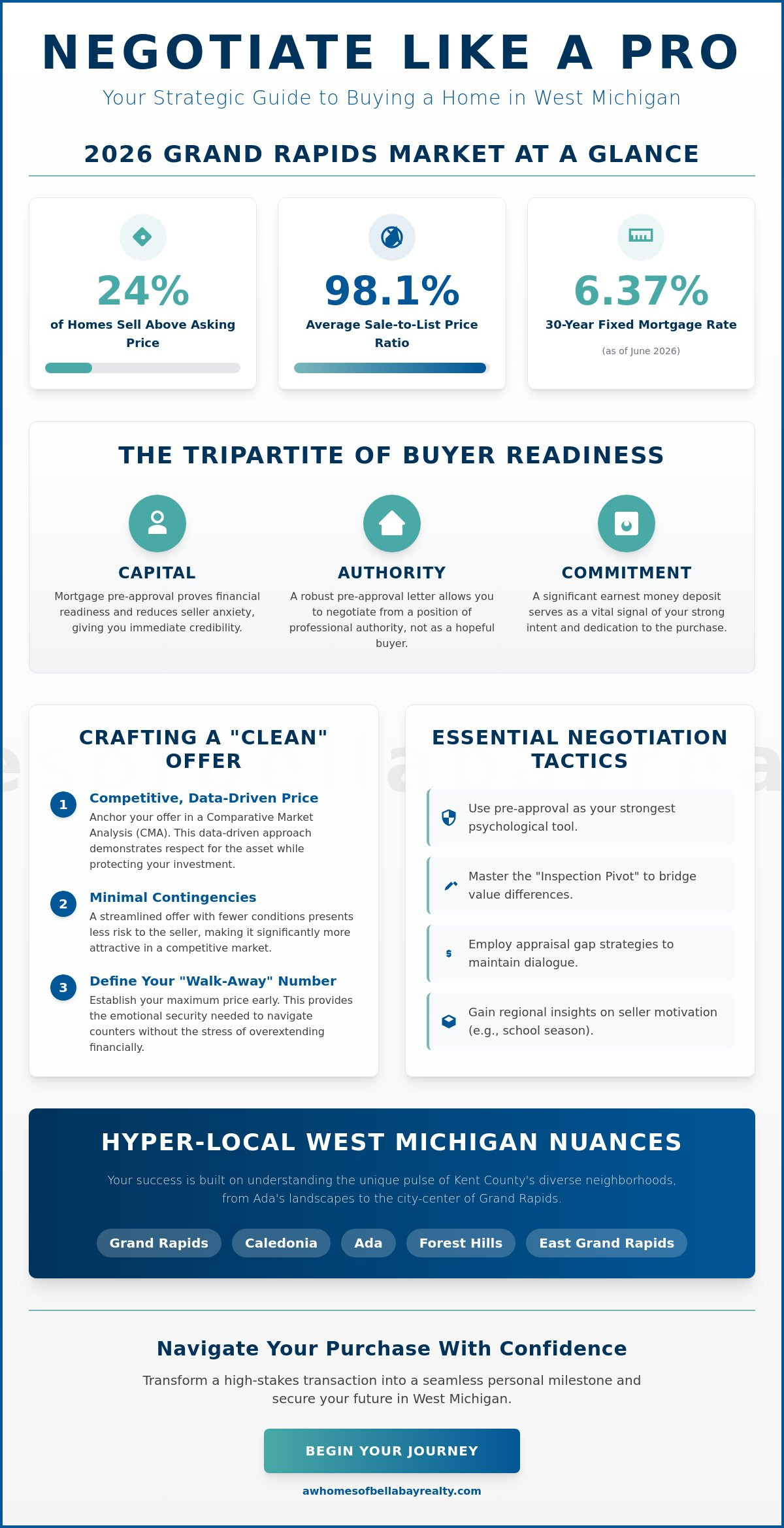
In a market where 24% of Grand Rapids homes are still selling above the asking price, understanding how to negotiate home price with seller is the difference between overpaying and making a wise investment. You want to secure your future without overextending your finances, yet the fear of losing your dream home in a competitive landscape is very real. It's completely understandable to feel tension around the haggling process, the complexity of contingencies, and the shifting rules of modern real estate. You deserve a transition that feels grounded in logic, expert insight, and emotional security.
This guide will empower you with the tools to master the art of strategic negotiation while maintaining professional poise and focus. By understanding the specific nuances of the 2026 West Michigan market, you can secure a fair purchase price, favorable closing terms, and a truly stress-free move. We'll examine current mortgage trends, regional price data from Caledonia to Grand Rapids, and the essential role of the new buyer-broker agreements in your negotiation journey. This methodical approach ensures that no detail is left to chance, allowing you to move forward with absolute confidence.
Key Takeaways
- Understand why financial pre-approval is your strongest psychological tool, establishing professional authority before the first offer is even submitted.
- Master the art of how to negotiate home price with seller by focusing on "clean" offer terms and defining your walk-away number early.
- Use the "Inspection Pivot" and appraisal gap strategies to bridge value differences while maintaining a fair and transparent dialogue with the seller.
- Gain regional insights into West Michigan’s unique neighborhoods, including how the Grand Rapids school season influences seller motivation and price flexibility.
- Learn how professional, concierge-style guidance transforms a high-stakes transaction into a seamless personal milestone and a secure life transition.
The Foundation of Negotiation: Preparation and Market Intelligence
Real estate negotiation is far more than a simple exchange of numbers; it's a strategic dialogue designed to create mutual value between a buyer and a seller. To succeed, you must move beyond the stress of haggling and adopt a consultant’s mindset. Understanding various negotiation strategies allows you to approach the table with poise rather than pressure. In our regional market, your success is built upon a tripartite of readiness: capital, credit, and commitment. This foundation ensures that when you find the right home in Grand Rapids or Ada, you are prepared to act with precision and intentionality. By viewing the transaction as a significant personal milestone, you can navigate the process with the calm focus required for a successful life transition.
Securing Your Financial Positioning
In 2026, a mortgage pre-approval is the essential entry fee for any serious negotiation. With 30-year fixed mortgage rates at 6.37% as of June 2026, sellers are prioritizing buyers who have already navigated the complexities of financing. Providing proof of funds or a robust pre-approval letter immediately reduces seller anxiety, especially in high-stakes West Michigan transactions where certainty is a premium commodity. This financial clarity allows you to speak from a position of professional authority. Negotiation leverage is the intersection of buyer readiness and seller urgency. When you eliminate the uncertainty regarding your funding, you allow the seller to focus on the logistics of their own move, creating a smoother path toward a fair purchase price and favorable terms.
Analyzing Local Market Comps
National headlines often fail to capture the specific pulse of Kent County. While broader trends provide context, the West Michigan Edge comes from analyzing local data points like the 98.1% sale-to-list price ratio currently seen in Grand Rapids. A Comparative Market Analysis (CMA) helps you distinguish between a seller’s aspirational asking price and the true market value based on recent local transitions. In neighborhoods like Ada or Forest Hills, these nuances are critical for your strategy. You can find a buyers agent in Grand Rapids to help interpret these metrics and identify where how to negotiate home price with seller becomes a matter of data rather than guesswork. This expert navigation ensures you don't overpay in a market where 24% of homes still sell above list price. By anchoring your offer in localized reliability, you move the conversation away from chance and toward expert planning.
Crafting the Offer: A 5-Step Strategic Framework
Negotiating a home purchase requires a methodical approach that balances financial precision with emotional intelligence. A "clean" offer package is your most effective tool, consisting of three core pillars: a competitive price, minimal contingencies, and a significant earnest money deposit. This deposit serves as a vital signal of intent, proving to the seller that your commitment is as strong as your capital. Before submitting the first document, you must determine your "walk-away" number. This boundary provides the emotional security needed to navigate counters without the stress of overextending. Utilizing essential negotiation strategies often involves framing your purchase as a "personal evolution." By aligning your needs with the seller's desire for a smooth transition to their own next chapter, you create a partnership rather than a conflict.
Step 1: Establishing the Baseline Price
In East Grand Rapids, where the average home value often exceeds the city median of $313,257, justifying your starting point requires hyper-local data. With 2026 inventory hovering at approximately 2.5 months of supply, you must assess whether the home is priced for a quick sale or positioned for a long-term listing. Offering significantly below list price in a market where 24% of homes sell above asking can be a "lowball" trap that ends the conversation prematurely. Instead, use recent comparable sales to build a logical case for your price. This data-driven approach demonstrates respect for the seller's asset while protecting your long-term well-being. Understanding how to negotiate home price with seller begins with this baseline, ensuring your offer is taken seriously from the moment it lands on their desk.
Step 2: Optimizing the Timeline
Price is rarely the only variable that matters to a seller. In West Michigan, many families are navigating their own high-stakes relocations and may value a flexible closing date over a few thousand dollars in the purchase price. A "Seller Rent-Back" agreement can be a powerful concession, allowing the seller to remain in the home for a set period after closing. This creates a stress-free transition for them and positions you as a highly competent partner who prioritizes their long-term needs. Balancing this logistical speed with your own due diligence ensures that your move remains a positive development in your life story. If you're ready to design an offer that stands out, our team can provide the expert guidance needed to secure your next home with professional poise.
Leveraging Terms and Contingencies for Maximum Value
While the headline price often captures the most attention, the true value of a real estate transaction is frequently found within the fine print of the contract terms. Mastering how to negotiate home price with seller involves a sophisticated understanding of contingencies, timelines, and financial credits. These elements act as a series of strategic levers that can be adjusted to offset a higher purchase price or to secure a more favorable long-term financial position. Understanding the Michigan home closing process is essential for defining these terms with precision. By viewing these negotiations as a methodical alignment of goals, you ensure that your transition is grounded in both logic and emotional security.
The Inspection as a Negotiation Tool
In the refined neighborhoods of Ada or Cascade, property inspections are not just about discovery; they are a vital pivot point in the negotiation. You must distinguish between significant safety issues, structural concerns, and minor cosmetic preferences. While a seller might ignore requests for fresh paint, they are often motivated to address electrical updates or roof repairs to keep the deal moving toward a successful closing. In 2026, requesting a repair credit is often more effective than a direct price reduction. A credit provides you with immediate capital to address the work after you take possession, while a price reduction only marginally lowers your monthly mortgage payment. Maintaining a professional, calming tone during this phase prevents the dialogue from becoming adversarial, ensuring the seller remains a willing partner in your life transition.
Navigating the Appraisal Gap
With home values in Grand Rapids continuing to appreciate, it's common for a bank's appraisal to fall short of a highly competitive negotiated price. This appraisal gap requires a strategic response to keep the transaction alive without compromising your financial security. Utilizing an Appraisal Guarantee clause allows you to commit to covering a specific portion of the difference in cash, which provides the seller with the certainty they crave. This approach protects your down payment by setting a clear limit on your exposure while demonstrating your commitment to the property. It's a methodical way to bridge the value difference, moving the conversation away from chance and toward expert navigation. By planning for these gaps early, you can secure your dream home with professional poise, even in a fast-moving market.
Seller concessions also play a pivotal role in modern negotiations. Asking for a closing cost credit can help offset the 6.37% mortgage rates seen in June 2026, making the home more affordable without requiring the seller to lower their headline price. This creates a win-win scenario where the seller achieves their target number and you preserve your liquid cash for future home improvements.
West Michigan Market Nuances: Grand Rapids to Caledonia
Negotiation in West Michigan is a hyper-localized endeavor. Strategies that work for luxury homes in Grand Rapids differ significantly from those applied to suburban starter homes. In high-end enclaves like Forest Hills or Ada, sellers often prioritize privacy, discretion, and seamless transitions. Conversely, in Caledonia, where homes spend an average of only 4 days on the market as of May 2026, your approach must be swift and decisive. Understanding how to negotiate home price with seller requires a deep dive into these neighborhood-specific rhythms. By aligning your offer with the unique pulse of the community, you transform a standard transaction into a strategic partnership.
In Kent County, the speed of the market dictates your level of aggression. With Grand Rapids homes averaging just 6 days on the market, there is little room for hesitation. If a property has exceeded this average, it often signals a natural opening to discuss price adjustments or seller concessions. This data-driven perspective moves your decision-making away from chance and toward expert navigation. We view these regional markers not just as statistics, but as the essential framework for your personal evolution and emotional security.
Neighborhood-Specific Leverage
Ada and Cascade remain high-demand, low-inventory enclaves where leverage is found in the flexibility of your terms rather than a lower price point. In these luxury markets, a "clean" offer with fewer contingencies often carries more weight than a slightly higher bid. In growing communities like Caledonia and Byron Center, move-up buyers can find opportunities by aligning their offers with the seller's relocation timeline. Local school district rankings act as a stabilizing force for long-term property value, ensuring that negotiation floors remain robust even during broader economic shifts.
Seasonality and Timing in West Michigan
The "Grand Rapids School Season" creates a predictable surge in seller motivation during the late spring. Families often aim to be settled before the academic year begins, which can lead to increased price flexibility as the summer progresses. While the spring market requires bold tactics to win in multiple-offer scenarios, the "Winter Advantage" offers a quieter window for strategic dialogue. Buyer competition drops significantly during the colder months, providing a more unhurried environment to secure favorable terms. Utilizing a Grand Rapids relocation guide can help you time your entry to maximize these seasonal shifts. If you're ready to navigate these local nuances with professional poise, contact our team today to begin your transition.
The AW Homes of Bellabay Realty Approach: Expert Navigation for Seamless Transitions
At AW Homes of Bellabay Realty, we believe that a real estate transaction is much more than a financial exchange; it's a significant personal milestone in your life story. Our approach is grounded in the concept of personal evolution, where every move represents a positive development in your journey. Angela Worth’s "Strategic Focus" moves the conversation beyond simple salesmanship and into the realm of high-level consulting. By positioning ourselves as your strategic advisors, we ensure that your transition into a new West Michigan home is characterized by expertise, empathy, and execution. We view our role as steady, knowledgeable professionals who are deeply invested in the long-term well-being of the local community.
Our methodology is designed to mitigate the inherent stress of high-stakes negotiations through a structured and rhythmic process. We don't just facilitate a closing; we curate a journey that prioritizes your peace of mind and emotional security. This concierge-style service ensures that no detail is left to chance, providing a sense of order that reinforces our promise of a stress-free experience. Whether you're moving within East Grand Rapids or relocating to the growing communities of Kent County, our team acts as a highly competent partner who prioritizes your future over a quick transaction.
The Power of Professional Representation
Communicating exclusively through a dedicated consultant from AW Homes of Bellabay Realty prevents the emotional deal-killers that often arise during direct negotiations. In the heat of a counter-offer cycle, having a calming authority at your side is your most powerful asset. Our team is trained to identify "hidden" seller motivations, such as specific timeline needs or tax-related closing preferences, that can be used to strengthen your position. When you understand how to negotiate home price with seller through a professional intermediary, you move away from the friction of haggling and toward a strategic alignment of goals. This professional buffer ensures that the dialogue remains productive, logical, and focused on your future.
Your Next Chapter Starts Here
We view your home purchase as an integral part of a broader life transition strategy. Every decision we make together is aimed at ensuring your move is a seamless and rewarding experience. The AW Homes of Bellabay Realty promise is built on three essential pillars: a stress-free process, an organized transition, and a successful closing. We don't just find you a house; we help you secure the foundation for your next chapter with professional poise. We invite you to schedule a strategic consultation to begin your 2026 home search. Let us provide the expert insight and localized reliability you need to turn your West Michigan dream into a reality.
Securing Your Future with Professional Poise
Securing your dream home in West Michigan requires a sophisticated blend of methodical planning, localized insight, and professional poise. You've discovered that financial readiness is your strongest psychological tool and that strategic contingencies can bridge the gap between a competitive offer and a winning one. Mastering how to negotiate home price with seller is not a battle of numbers; it's a curated journey toward your next significant life milestone. By aligning your goals with the seller's needs, you ensure a transition that is grounded in logic and emotional security.
At AW Homes of Bellabay Realty, we provide the expert West Michigan market authority and concierge-style buyer representation needed to navigate the unique landscape of 2026. Our strategic focus on emotional security and seamless transitions ensures that no detail is left to chance, from the initial market analysis to the final walk-through. Your personal evolution deserves a partner who understands the nuances of Grand Rapids, Ada, and Caledonia with unhurried precision. We prioritize your long-term well-being over a quick closing, acting as a steady, knowledgeable partner in your success.
Ready to move forward with absolute confidence? Schedule your strategic home buying consultation with Angela Worth today to begin your 2026 home search. Your next chapter is waiting, and we're here to ensure the path is steady, logical, and supportive.
Frequently Asked Questions
How much lower than the asking price can I offer in Grand Rapids?
Offering approximately 1% to 2% below the list price is typically the realistic limit in the current market. With a sale-to-list price ratio of 98.1% in Grand Rapids, sellers expect offers that closely align with their valuation. If a property has remained on the market beyond the 6-day average, you may find more room for dialogue. However, starting with a logical, data-backed number maintains the professional rapport necessary for a successful life transition.
Is it okay to ask the seller for repairs after a home inspection?
Yes, requesting repairs is a standard part of the "Inspection Pivot" to ensure your future home is structurally sound. You should focus your requests on significant safety or mechanical issues rather than minor cosmetic preferences. In 2026, many buyers find that securing a repair credit is more effective than asking the seller to perform the work. This approach provides you with expert control over the quality of repairs while keeping the closing process steady and unhurried.
What are seller concessions, and should I ask for them in 2026?
Seller concessions are credits provided by the seller to cover your closing costs or buy down your mortgage interest rate. With 30-year fixed rates at 6.37% as of June 16, 2026, these concessions are a strategic tool to improve your monthly affordability. They are particularly valuable in growing communities like Caledonia where buyers want to preserve liquid capital. This methodical financial planning ensures your move remains a positive development in your personal evolution.
How do I handle a multiple-offer situation without overpaying?
Managing multiple offers requires a clear "walk-away" number established before the inherent stress of competition begins. Instead of simply increasing the price, focus on crafting a "clean" offer with a flexible closing date or a higher earnest money deposit. This strategic focus demonstrates your commitment to the seller's next chapter without compromising your long-term well-being. It's about finding a logical balance between your financial boundaries and the seller's specific transition needs.
What is an escalation clause, and when should I use one in West Michigan?
An escalation clause is a contract addendum where you agree to increase your offer by a set amount over the highest competing bid, up to a specific limit. You should use this in high-demand enclaves like Forest Hills or Ada when competition is intense. This tool allows you to stay competitive automatically while protecting your financial security with a firm cap. It moves the process away from chance and toward a more organized, methodical victory.
Can I negotiate the price if the home appraisal comes in low?
Yes, a low appraisal creates a natural opportunity to reopen the dialogue regarding the purchase price. You can ask the seller to reduce the price to the appraised value, bridge the gap with an appraisal guarantee, or negotiate a middle ground. Understanding how to negotiate home price with seller during an appraisal gap involves protecting your down payment while keeping your personal milestone on track. This expert navigation ensures the transaction remains grounded in logical market values.
How do I find out why the seller is moving to gain leverage?
Your buyer's agent identifies these hidden motivations through professional dialogue with the listing agent. Learning if a seller is relocating for a job or needs to settle before the Grand Rapids school season begins provides essential leverage. This insight allows you to craft an offer that solves the seller's logistical problems. By positioning yourself as a high-level partner in their transition, you often find that favorable terms become more accessible than through price alone.
What should I do if the seller rejects my offer without a counter-offer?
If an offer is rejected outright, you should reassess your strategy with a composed and logical perspective. Ask your agent to gather feedback to determine if the issue was price, terms, or a lack of financial certainty. Sometimes, a seller simply needs more time to realize the market value of their home. Staying patient and maintaining your professional poise allows you to pivot toward a new opportunity without the emotional strain of a high-pressure situation.


