

Last spring, a family closed on their dream home in Ada, only to be blindsided months later by a tax bill that was significantly higher than the previous owner's. This "tax shock" is a common reality for buyers who don't account for the way Michigan uncaps property values after a sale. While the average property tax rate Kent County MI is approximately 1.03%, that single percentage doesn't tell the whole story of your future monthly payment. You likely believe that budgeting for your home should be a straightforward process, yet the shifting landscape of local millage rates and school district assessments can make your financial planning feel like guesswork.
We believe that every homeowner deserves a clear, predictable path toward their next transition. This strategic guide will empower you to master the 2026 tax environment with professional insight and localized expertise. You'll learn how the 2.7% inflation rate multiplier affects your bottom line, how to navigate the technical differences between SEV and Taxable Value, and how to utilize exemptions to protect your investment. By the end of this article, you'll have the tools to compare neighborhoods with confidence, ensuring your chosen community aligns with your financial security, lifestyle goals, and long-term peace of mind.
Key Takeaways
- Understand how the average property tax rate Kent County MI, typically ranging between 30 and 55 mills, impacts your monthly mortgage and long-term budgeting.
- Navigate the technical differences between State Equalized Value and Taxable Value to gain a precise understanding of your home’s true financial carry-costs.
- Evaluate the tax efficiency of specific communities, comparing the high-service model of East Grand Rapids with the strategic advantages of townships like Ada or Cascade.
- Prepare for the "uncapping" effect after a purchase to ensure your transition remains seamless, secure, and free from unexpected financial surprises.
- Shift your perspective from simple home pricing to a comprehensive analysis of tax millages, school district assessments, and localized investment value.
Understanding the Average Property Tax Rate in Kent County, MI
Your home is a sanctuary, a milestone, and a significant financial commitment. Understanding the math behind your annual tax bill is the first step toward achieving total peace of mind in your new neighborhood. In Michigan, property taxes are calculated using "mills." One mill represents one dollar of tax for every one thousand dollars of your property’s taxable value. This distinction is vital because your taxable value is often much lower than your home's actual market price, especially if you've owned the property for several years.
The average property tax rate Kent County MI typically fluctuates between 30 and 55 mills. This variation depends entirely on your specific municipality and school district. When you're calculating your potential carry-costs, it's helpful to remember that you'll receive tax statements twice each year. The Summer bill arrives in July and generally includes the majority of your school and state education taxes. The Winter bill follows in December, covering county-level services and specific local assessments. By analyzing the average property tax rate Kent County MI through this dual-season lens, you can create a more accurate and reliable monthly budget.
These rates aren't static figures imposed from above; they are the result of community choices. Residents frequently vote on specific millages to fund local parks, regional zoos, and essential emergency services. This democratic process allows Kent County to maintain high-end amenities while giving you a voice in how your tax dollars are utilized. We view these payments not just as expenses, but as investments in the localized reliability and warmth of your community.
Why Rates Vary Across West Michigan
Local priorities shape your tax liability. Millage rates are influenced by local school district debt, regional library systems, and specialized city assessments. These figures are grounded in the 1994 Michigan Proposal A, which restructured how our state funds public education. School debt is the largest variable. City residents also pay specific city millages that township residents in areas like Ada or Cascade do not encounter.
The Role of the Kent County Treasurer
The Kent County Treasurer’s office focuses on the collection of delinquent taxes and the distribution of revenue. Property assessments are handled at the local city or township level, not by the county. Most bills include a 1% administration fee to support these logistical processes. We help our clients understand these methodical details to ensure their long-term financial security during every property transition.
The Mechanics of Michigan Property Taxes: SEV vs. Taxable Value
Understanding the difference between what your home is worth and what you're taxed on is the cornerstone of financial security. In Michigan, these are two distinct figures: State Equalized Value (SEV) and Taxable Value. The SEV is required by law to represent 50% of your property’s true cash value. However, the figure that actually dictates your bill is the Taxable Value. For homeowners in the 2026 market, the average property tax rate Kent County MI is applied directly to this Taxable Value, which is often significantly lower than the SEV due to long-term protections.
These protections stem from the Headlee Amendment and subsequent state laws. These regulations ensure that your Taxable Value cannot increase by more than 5% or the rate of inflation, whichever is lower. For the 2026 tax year, the inflation rate multiplier is set at 1.027. This means existing homeowners who haven't transferred ownership will see a modest 2.7% cap on their value increases. This system provides a predictable, steady, and supportive framework for your household budget. Information regarding these specific calculations and collection schedules can be found through the Kent County Treasurer's Office, which serves as a vital resource for local homeowners.
Principal Residence Exemption (PRE) Explained
The Principal Residence Exemption is one of the most effective ways to lower your annual costs. It typically saves homeowners approximately 18 mills on their school operating taxes. To qualify for this benefit, the property must be your primary residence, and you must file an affidavit by June 1st for the summer levy or November 1st for the winter levy. The PRE is a critical tool for reducing the carry-cost of your home and ensuring your transition is financially sustainable. If you're considering a move, our buyer agency services can help you calculate the specific impact of this exemption on your future monthly payment.
How Assessments Are Determined
Local assessors review market sales data annually to determine the SEV of properties within their jurisdiction. While the average property tax rate Kent County MI stays relatively consistent, your specific assessment can change based on physical improvements. Adding a finished basement, building a deck, or completing a major renovation will likely trigger an increase in your Taxable Value. If you believe your assessment doesn't reflect the current market fairly, you have the right to appeal at the March Board of Review. This process ensures that your tax burden remains equitable, transparent, and grounded in reality.
Comparing Millage Rates Across Greater Grand Rapids Neighborhoods
Choosing a neighborhood is a decision that balances heart and home with a sharp eye for long-term value. While the average property tax rate Kent County MI serves as a helpful baseline, the true cost of living is revealed when we look at specific municipality levies. We help you analyze the three pillars of local taxation: school district debt, township services, and voter-approved millages. This methodical approach ensures that your next move is grounded in financial clarity and emotional security. In the City of Grand Rapids, for example, residents pay specific city millages and a city income tax. These costs fund urban infrastructure, localized safety, and vibrant community programs that define the city's character.
The Forest Hills Public Schools district is a prime example of how geography influences your bill. This district spans multiple municipalities, including Ada, Cascade, and Grand Rapids Township. Because each township has its own local millage rate for services like fire protection and library systems, two families in the same school district may pay slightly different amounts. While the average property tax rate Kent County MI provides a broad overview, your specific street address determines your final millage. We believe that understanding these nuances is essential for move-up buyers who want to maximize their purchasing power without sacrificing the quality of their environment.
Ada vs. Cascade: A Strategic Comparison
Both Ada and Cascade Townships are highly sought after for their connection to Forest Hills Schools, yet they offer different tax profiles. Ada Township’s focus on land preservation, park development, and rural character is reflected in its local levies. These investments maintain the township's scenic beauty and open spaces. In contrast, Cascade Township offers a robust commercial tax base, proximity to retail, and balanced residential levies. This commercial activity helps offset the tax burden for homeowners, providing a different kind of strategic advantage for your long-term financial goals.
The East Grand Rapids Premium
East Grand Rapids is defined by its walkable streets, dedicated police and fire services, and top-tier school rankings. These localized services are funded by higher millage rates, which EGR residents view as a strategic trade-off for a unique urban-suburban lifestyle. For luxury buyers, these higher rates can impact total purchasing power. We act as your consultant to ensure you understand how these costs integrate into your overall wealth strategy. Methodical planning in EGR ensures that your investment supports a lifestyle of excellence, community, and personal evolution.
Planning for the 'Uncapping' Effect After a Home Purchase
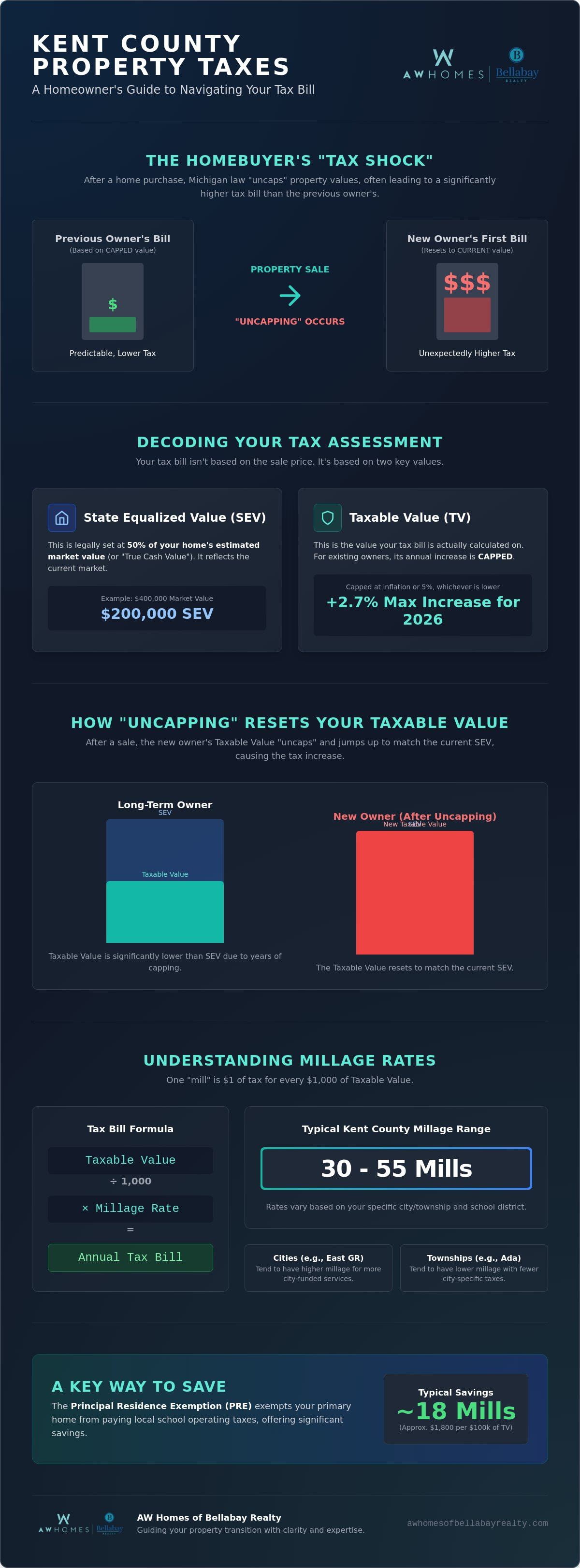
The excitement of a successful closing should never be overshadowed by an unexpected financial burden. In Michigan, the most significant variable in your long-term carry-cost is the "uncapping" of your property’s Taxable Value. While the average property tax rate Kent County MI remains a steady metric, the value it is applied to resets entirely when ownership transfers. If the previous owners occupied the home for decades, their Taxable Value was likely capped far below the current market reality. Relying on their tax bill for your 2026 budget is a common mistake that can lead to a 20-50% increase in your annual liability. We prioritize your financial clarity, emotional security, and long-term peace of mind by helping you look beyond the current bill.
Strategic buyers view the State Equalized Value (SEV) as the true North Star for their future budgeting. Because the SEV represents 50% of the market value, it serves as the baseline for where your taxes will land once the "reset" occurs. This methodical approach removes the element of chance from your property transition. Understanding these mechanics is especially vital in high-demand areas like Forest Hills or East Grand Rapids, where market values have risen sharply. If you are preparing for a move, our relocation assistance provides the methodical analysis you need to avoid these common pitfalls and ensure your new chapter begins on solid financial footing.
Calculating Your Post-Sale Tax Bill
To find a reliable estimate, use this professional formula: (New SEV x Millage Rate) / 1,000 = Estimated Annual Tax. The "uncapping" occurs on January 1st of the year following the transfer. This delayed effect often creates a false sense of security during your first few months in the home. We recommend consulting with a real estate expert to run these numbers during your due diligence period. This step ensures that your offer is grounded in the actual average property tax rate Kent County MI for your specific neighborhood.
Escrow Adjustments and Shortages
Mortgage companies often underestimate taxes in the first year of ownership because they base their initial escrow analysis on the seller’s capped rate. When the taxes eventually uncap, it can lead to significant escrow shortages and a sudden spike in your monthly payment. You'll then be responsible for both the higher tax rate and the catch-up payments for the previous year's deficit. To avoid this, proactively communicate with your lender about the anticipated SEV reset. This foresight keeps your transition steady, logical, and supportive of your broader financial goals.
Navigating Your Property Transition with AW Homes
A home transition is more than a simple real estate transaction; it's a significant personal milestone and a step toward your personal evolution. We believe that achieving emotional security during this process requires a sophisticated blend of professional authority and methodical planning. While understanding the average property tax rate Kent County MI is a vital first step, our concierge-style approach at AW Homes of Bellabay Realty ensures that every financial nuance is examined with precision. We don't just show properties. We provide strategic focus, localized reliability, and expert insight into the long-term carry-costs of your next investment.
Our work is grounded in the belief that no detail should be left to chance. For move-up buyers and relocation clients, AW Homes of Bellabay Realty helps compare neighborhoods not just by the aesthetic of the homes, but by their inherent tax efficiency. We analyze how different millage rates in areas like Forest Hills, Ada, and Grand Rapids will interact with your specific financial goals over the next decade. By positioning ourselves as high-level consultants rather than high-pressure salespeople, we create an atmosphere of trust and warmth that allows you to focus on the excitement of your new chapter. The average property tax rate Kent County MI is merely one variable in a much larger, curated journey toward your future home.
The AW Homes of Bellabay Realty Consultation Advantage
We provide a level of service that distinguishes us from generalist competitors through specialized expertise tailored to your life stage. During our consultation process, AW Homes of Bellabay Realty provides customized market analyses that include specific tax projections for your target neighborhoods. This transparency mitigates the inherent stress of high-stakes transactions by providing a clear, logical, and supportive framework for decision-making. Our goal is to ensure your transition is seamless and your financial future is secure. For comprehensive move-in support, we invite you to explore our Grand Rapids Relocation Guide, which serves as a strategic roadmap to the West Michigan landscape.
Ready for Your Next Chapter?
Whether you're moving up to a larger estate or downsizing for a more intentional lifestyle, we're here to manage the complexities of the West Michigan market. Strategic planning. Expert navigation. Personal growth. These are the pillars of our partnership with you at AW Homes of Bellabay Realty. We prioritize your long-term well-being over a quick closing, ensuring that every move you make is a positive development in your life story. Contact Angela Worth today to begin a partnership built on local authority and professional integrity. To take the first step toward a stress-free experience, schedule a strategic consultation with AW Homes of Bellabay Realty today.
Securing Your Financial Peace in West Michigan
Your next home is the foundation for your family’s personal evolution and long-term security. We've explored how the average property tax rate Kent County MI serves as a vital baseline, yet the true math of homeownership lies in the nuances of millage variations and post-sale uncapping. By mastering the distinction between SEV and Taxable Value, you move away from financial chance and toward expert navigation. Whether you're drawn to the walkable charm of East Grand Rapids or the serene landscapes of Ada and Forest Hills, localized knowledge remains your greatest asset for a predictable budget.
AW Homes of Bellabay Realty is dedicated to providing the concierge-style service and expert guidance on West Michigan market trends you need for a stress-free experience. No detail is left to chance when you have a partner who views your property transition as a significant personal milestone. Partner with AW Homes of Bellabay Realty for a strategic approach to your next property transition and gain the clarity required for a confident move. Your future in Greater Grand Rapids is a journey we're honored to guide with steady, knowledgeable, and supportive care.
Frequently Asked Questions
How is property tax calculated in Kent County, MI?
Property tax is calculated by multiplying your home's Taxable Value by the local millage rate and then dividing that figure by 1,000. While the average property tax rate Kent County MI provides a helpful baseline for your budget, your final bill depends on the specific millages approved by voters in your city, township, and school district. This methodical approach ensures your tax burden is tied directly to the localized services provided in your immediate community.
What is the current millage rate for Grand Rapids Public Schools?
The millage rate for Grand Rapids Public Schools is part of a total levy that typically ranges between 30 and 55 mills for homestead properties. This total includes school operating millages, debt service, and county-wide assessments for libraries and regional parks. Because these rates are adjusted annually based on local debt and voter approvals, you should review your specific July and December statements for the most accurate breakdown of your district's contribution.
Does Kent County have a city income tax?
Kent County does not levy a county-wide income tax, but specific municipalities like the City of Grand Rapids and the City of Walker do. If you live or work within these city limits, you'll pay a local income tax in addition to your property taxes. This is a crucial factor to consider when comparing the total carry-costs of a city residence versus a township location like Ada or Cascade, where no income tax is required.
What is the Principal Residence Exemption (PRE)?
The Principal Residence Exemption is a state program that exempts your primary home from up to 18 mills of local school operating taxes. To qualify, you must own and occupy the property as your main residence and file an affidavit with your local assessor. Filing by the June 1st or November 1st deadlines ensures this benefit is reflected in your summer or winter tax bills, significantly reducing your annual costs.
Why did my property taxes go up so much after I bought my house?
Your taxes increased because of the "uncapping" process that occurs during a transfer of ownership. In the year following your purchase, the Taxable Value resets to match the State Equalized Value, which is 50% of the property's market value. This reset often leads to a significant jump if the previous owner held the home for many years, as they were protected by annual caps that you have now inherited at a higher market level.
When are property taxes due in Kent County?
Property taxes are billed twice a year with distinct deadlines for the summer and winter cycles. Summer taxes are typically mailed on July 1st and are due by September 14th without penalty. Winter taxes are mailed on December 1st and must be paid by February 14th. Staying mindful of these dates is essential for maintaining your financial security and avoiding the late interest charges that can disrupt your long-term budgeting goals.
How can I appeal my property tax assessment in Kent County?
You can appeal your assessment by appearing before your local March Board of Review. When you receive your Assessment Notice in February, review the SEV and Taxable Value to ensure they reflect current market conditions fairly. If you believe the value is inaccurate, you'll need to provide evidence, such as a recent professional appraisal or comparable sales data, to support your request for an adjustment during the board's scheduled meetings.
What is the Headlee Amendment and how does it protect homeowners?
The Headlee Amendment protects homeowners by limiting the annual increase in Taxable Value to 5% or the rate of inflation, whichever is lower. For the 2026 tax year, the inflation multiplier is set at 1.027, meaning existing homeowners will see their values capped at a 2.7% increase. This regulation ensures that the average property tax rate Kent County MI remains manageable and predictable, even when local real estate market values are rising rapidly.


