

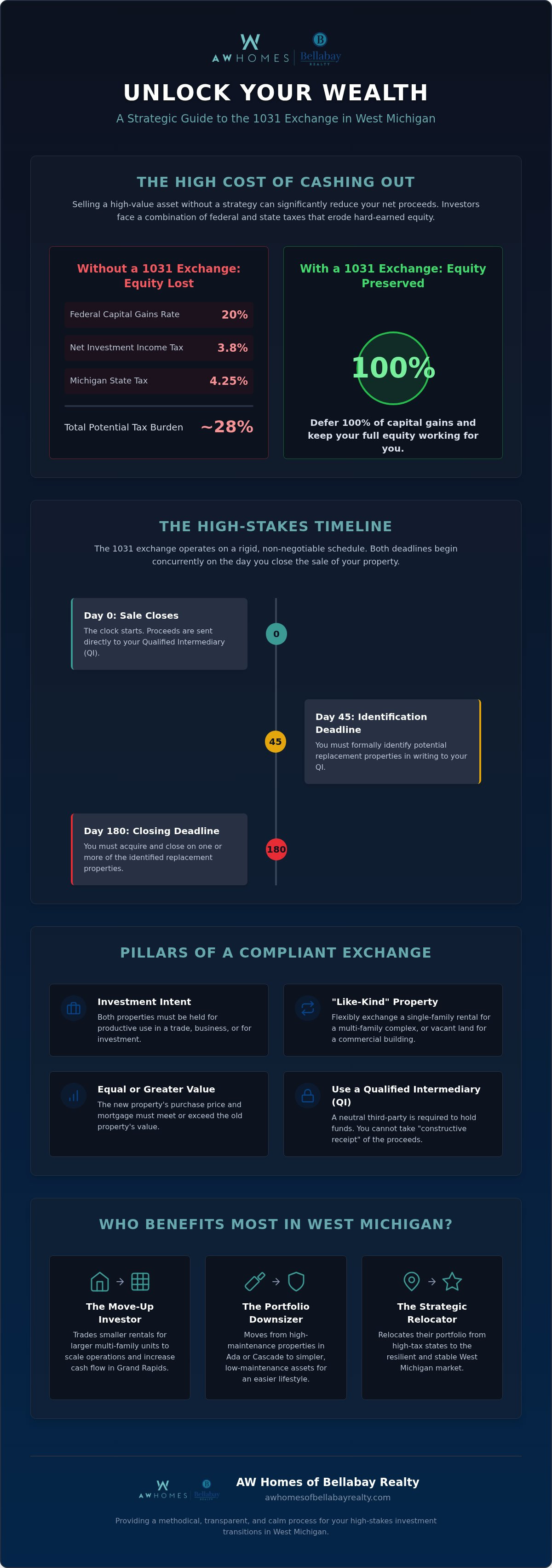
What if your next West Michigan real estate acquisition was funded entirely by the taxes you never had to pay? For many seasoned investors, the prospect of selling a high-value asset is often clouded by the reality of a 20% federal capital gains rate, a 4.25% Michigan state tax, and the 3.8% Net Investment Income Tax. It's understandable to feel a sense of hesitation when facing these high stakes. When you explore the 1031 exchange properties Michigan provides, you aren't just looking for a new building. You're seeking a strategic transition that preserves your hard-earned equity, secures your family's future, and anchors your wealth in our local community.
We understand that the 45-day identification window can feel restrictive and the fear of an IRS audit is a heavy burden to carry. You deserve a process that is methodical, transparent, and calm. This guide provides the clarity you need to defer 100% of your capital gains taxes while upgrading to higher-performing assets in Grand Rapids, Ada, or Cascade. We will walk through the essential 2026 deadlines, clarify like-kind property definitions, and outline a step-by-step roadmap for a seamless exchange that prioritizes your long-term well-being.
Key Takeaways
- Understand how to defer 100% of capital gains and depreciation recapture by following federal IRC Section 1031 guidelines within the Michigan landscape.
- Gain clarity on the critical 45-day identification window and the 180-day closing rule to prevent costly tax liabilities and ensure a seamless transition.
- Explore the most resilient neighborhoods in West Michigan, including Cascade and East Grand Rapids, to find high-performing 1031 exchange properties Michigan.
- Learn how to leverage broad like-kind definitions to transition your portfolio from single-family rentals into more lucrative multi-family assets or commercial opportunities.
- Discover the value of a concierge-style real estate partner who provides a methodical, calming approach to managing high-stakes investment transitions.
Understanding the Michigan 1031 Exchange Landscape in 2026
Real estate investment is a journey of personal and financial evolution. In 2026, the strategy remains clear: preserve your capital to build a lasting legacy. A 1031 exchange serves as a sophisticated bridge, allowing you to transition between assets without the immediate burden of taxes. By adhering to the Internal Revenue Code section 1031, you can defer federal capital gains, the 3.8% Net Investment Income Tax, and Michigan's 4.25% flat income tax. Michigan follows federal rules strictly, meaning there are no additional state-level filings to complicate your journey.
Choosing to explore 1031 exchange properties Michigan provides is a decision to keep 100% of your equity working within your portfolio. Without this tool, an investor might lose 20% or more of their sale proceeds to various tax authorities. In a competitive 2026 market where inventory is tight and every dollar of purchasing power matters, this deferral is a critical advantage for growth in Grand Rapids and the surrounding townships. It's about intentionality, expert navigation, and long-term planning.
The Three Pillars of a Successful Exchange
A successful transition relies on three fundamental principles that ensure your compliance and peace of mind. First, you must establish investment intent; both the property you sell and the one you acquire must be held for productive use in a trade, business, or for investment. Second, the properties must meet the like-kind requirement. This definition is surprisingly flexible, allowing you to trade a single-family rental for an apartment complex or a vacant lot for a commercial office. Third, you must view this as tax deferral rather than avoidance. It's a methodical way to compound wealth over decades, moving your equity into higher-performing assets as your life stages change.
Who Should Consider a 1031 in West Michigan?
This strategy is ideal for those navigating significant life transitions or portfolio adjustments. We often work with three specific types of investors in the Kent County area who benefit from this focused approach:
- The Move-Up Investor: These individuals trade smaller residential rentals in Grand Rapids for larger multi-family units to increase cash flow, consolidate management, and scale their operations.
- The Portfolio Downsizer: Investors who are ready to move away from high-maintenance land or older homes in Ada and Cascade into low-maintenance, high-end condos that offer a simpler lifestyle.
- The Strategic Relocator: Clients moving their investment footprint from high-tax coastal states into the resilient and stabilizing West Michigan market to secure localized reliability.
Navigating the 1031 Exchange Timeline and Federal Requirements
Precision is the hallmark of a successful transition. The 1031 exchange is a high-stakes race against the clock where every second counts. According to 26 U.S. Code § 1031, the federal timeline is rigid and unforgiving. You have exactly 45 days to identify replacement properties and 180 days to close the transaction. These two windows run concurrently, beginning the moment you close on your sale. In a competitive market like Grand Rapids, where homes often receive six offers and sell in just seven days, searching for 1031 exchange properties Michigan investors can rely on must begin long before your first property sells.
A Qualified Intermediary (QI) is a non-negotiable partner in this methodical process. You cannot touch the sale proceeds. If you take "constructive receipt" of the funds, the IRS considers the sale a taxable event. The QI holds your equity in a secure account, ensuring the transition remains seamless and compliant. To defer the full tax burden, you must also follow the "equal or greater value" rule. This requires your new property to have a purchase price and mortgage balance that meets or exceeds those of the property you sold. We prioritize your equity, your timeline, and your peace of mind.
Five Steps to an IRS-Compliant Exchange
Success requires a structured approach to mitigate stress. Follow these five steps to ensure your wealth remains protected throughout the move:
- Step 1: Consult with a strategic real estate advisor to establish the accurate market value of your current asset.
- Step 2: List and sell your relinquished property while simultaneously engaging a professional Qualified Intermediary.
- Step 3: Formally identify up to three potential replacement properties within the strict 45-day identification period.
- Step 4: Execute a purchase agreement for your chosen replacement property with confidence and speed.
- Step 5: Close on the new property within the 180-day window using the funds held by your QI.
Common Pitfalls and How to Avoid Them
The most common failure is missing the identification deadline. In high-demand neighborhoods like Forest Hills or Ada, inventory levels hover around a mere 1.2 months. It is vital to have a backup list of properties ready. Another risk involves mortgage debt levels. If your new loan is smaller than the old one, the difference is considered taxable. Boot is any non-like-kind property or cash received in an exchange that becomes immediately taxable. If you feel the pressure of these strict federal deadlines, our real estate investment consulting provides the methodical search strategy you need to secure your next asset.
Strategic Reinvestment: Why West Michigan is a 1031 Stronghold
West Michigan real estate represents a sanctuary for capital in 2026. While other markets fluctuate, the Greater Grand Rapids area offers a unique blend of stability, resilience, and growth. With a median sale price hovering between $305,000 and $310,000 and a mere 1.2 months of inventory, the demand for quality assets remains intense. Investors utilize Section 1031 of the Federal tax code to pivot away from stagnant assets and into these high-demand corridors. This isn't just a tax move; it's a strategic repositioning into the most resilient neighborhoods in Kent County.
Our perspective as a neighborhood authority reveals that East Grand Rapids and Cascade continue to serve as anchors for long-term wealth. Identifying the right 1031 exchange properties Michigan offers requires a deep understanding of these micro-markets. For a comprehensive look at current trends, our Strategic Guide to Real Estate Investment Properties in Grand Rapids (2026) details why local inventory remains a hedge against national volatility.
Targeting High-Growth Areas: Ada and Forest Hills
The Forest Hills school district remains a primary driver for property value, as families prioritize educational excellence and community stability. This localized demand ensures that rental units in this area maintain high occupancy and consistent appreciation. We often focus on three specific factors when evaluating these high-growth areas:
- School District Quality: Superior educational ratings in Forest Hills drive long-term rental demand and protect property values.
- Village ROI: The shift toward lifestyle-oriented living in Ada has created a high-end, walkable market for investment property.
- Growth Density: Balancing suburban expansion with urban core density allows for diverse portfolio goals and risk mitigation.
The Move-Up Strategy for Investors
A significant trend in 2026 involves trading multiple entry-level rentals for a single, high-performing luxury home in Grand Rapids. This move-up strategy simplifies your life by reducing management overhead while increasing the total value of your holdings. Our concierge approach focuses on finding off-market opportunities that fit within your 45-day identification window. We prioritize your time, your equity, and your emotional security. By moving beyond simple salesmanship, we act as a high-level consultant to ensure your transition into executive housing is both seamless and rewarding.
Identifying Qualifying Like-Kind Properties in the Grand Rapids Area
Dispelling the "Like-Kind" myth is the first step toward true portfolio flexibility. Many investors mistakenly believe they must trade a duplex for another duplex or a retail space for a similar storefront. In reality, the IRS allows for incredible versatility. You can trade a vacant lot in Cascade for an apartment building in Grand Rapids or a single-family rental for a professional office space. It's a fact that "like-kind" refers to the nature or character of the property, not its grade or quality. This broad interpretation allows you to pivot your strategy based on your current life stage and financial goals without being tethered to a specific asset class.
Kent County offers a diverse range of 1031 exchange properties Michigan investors can use to rebalance their holdings. If you own raw land that isn't producing income, you might trade it for developed residential units to generate immediate cash flow. Vacation rentals in West Michigan also qualify, provided you adhere to strict guidelines regarding personal use and rental days. We focus on these transitions to ensure your portfolio remains both compliant and high-performing while moving you toward a more secure financial future.
The Three-Property Rule vs. The 200% Rule
Selecting your replacement assets requires a methodical strategy tailored to the 2026 market. The Three-Property Rule allows you to identify up to three potential properties regardless of their total market value. This is often the most reliable path in our current climate, where Grand Rapids inventory remains tight at 1.2 months. Alternatively, the 200% Rule lets you identify any number of properties as long as their combined value doesn't exceed double the sale price of your relinquished asset. Given that homes in our region sell in about 6-7 days, the Three-Property Rule usually provides the focus needed to secure a winning offer.
Diversifying Your Portfolio via 1031
A 1031 exchange is a powerful tool for geographic and asset-class diversification. You might choose to move equity from a single high-value asset in East Grand Rapids into multiple properties in Caledonia to spread your risk and increase your footprint. This shift allows you to transition from high-maintenance residential units into "lifestyle" investments that still meet every IRS requirement. Whether you're moving toward executive housing or multi-family units, the focus remains on personal evolution and localized reliability. If you're ready to explore specific inventory that meets these requirements, our buyer agency services can help you identify off-market opportunities that fit your timeline.
The Role of a Strategic Real Estate Partner in Your 1031 Transition
High-stakes transactions demand more than just technical knowledge; they require a partner who values your emotional security. A 1031 exchange is a complex journey of personal and financial evolution. While the tax benefits are clear, the logistical pressure of finding the right replacement asset can be overwhelming. A concierge-style real estate partner serves as a strategic consultant, providing the methodical guidance needed to navigate this transition with poise. By handling the sophisticated market positioning and professional photography of your sale, we ensure you enter the identification phase from a position of strength.
Localized reliability is the foundation of a successful reinvestment. Understanding the nuances of Kent County neighborhoods ensures your new asset provides both financial growth and peace of mind. We focus on neighborhood insight to identify 1031 exchange properties Michigan investors can trust for long-term stability. This expertise is vital when moving through the Michigan Home Closing Process guide, as we manage every detail to ensure your next chapter begins seamlessly.
Expert Navigation for Life Transitions
Specialized knowledge is essential when your investment goals shift alongside your life stages. Whether you're a move-up buyer seeking higher-performing multi-family units or a downsizer looking for luxury executive housing, your strategy must be intentional. Angela Worth’s methodical approach ensures no detail is left to chance during the critical identification period. We view each exchange as a significant personal milestone. Our process is designed to mitigate stress, emphasize security, and celebrate your progress. It's about precision, timing, and trust. We don't just close deals; we facilitate the evolution of your real estate legacy.
Getting Started with Your Michigan Exchange
The first step toward a successful 2026 exchange is an initial strategic consultation. This meeting allows us to determine if a 1031 is the right tool for your specific goals and to begin the search for replacement assets early. Our regional dominance in Grand Rapids, Ada, and Cascade provides you with access to off-market listings that generalist competitors often miss. These exclusive opportunities are vital when inventory is low and the 45-day clock is ticking. You deserve a partner who understands the West Michigan market and prioritizes your long-term well-being. Secure your legacy by choosing an advisor who turns complex tax strategies into a steady, supportive journey toward wealth.
Securing Your Legacy through Strategic Transitions
Navigating the complexities of a 1031 exchange is more than a simple tax strategy; it's a pivotal step in your financial evolution. By mastering the strict federal timelines and understanding the broad potential of like-kind assets, you protect your equity from significant 2026 tax liabilities. The search for 1031 exchange properties Michigan investors can rely on requires a deep, localized connection to our unique market. Whether you're scaling up to multi-family units or seeking the simplicity of luxury executive housing, your transition should be handled with precision, timing, and care.
You deserve a partner who provides a calming, methodical approach to these high-stakes milestones. As a neighborhood authority in West Michigan, we provide concierge-style real estate service tailored to your specific life stage. We ensure no detail is left to chance, from the first professional photograph to the final closing signature. When you're ready to pivot your portfolio with confidence, we're here to guide you. Schedule a Strategic 1031 Consultation with Angela Worth today. Your future in Grand Rapids is waiting, and we look forward to helping you build it.
Frequently Asked Questions
Can I do a 1031 exchange on a primary residence in Michigan?
No, you cannot use a 1031 exchange for a primary residence. This strategy is reserved for properties held for productive use in a trade, business, or as an investment. If you're selling your personal home in Grand Rapids, you may instead qualify for the Section 121 exclusion. This allows individuals to exclude up to $250,000 of gain, or $500,000 for married couples, provided they meet specific residency requirements.
How long do I have to identify a replacement property in a 1031 exchange?
You have exactly 45 calendar days from the date you close on your relinquished property to formally identify replacement assets. This period is rigid and includes weekends and holidays. It's the most high-pressure phase for finding 1031 exchange properties Michigan investors can secure. You must also complete the entire acquisition within 180 days. These two timelines run concurrently, requiring a methodical approach to ensure your transition remains seamless and compliant.
What is a Qualified Intermediary and do I need one for a Michigan 1031?
A Qualified Intermediary (QI) is a professional third party who facilitates the exchange by holding the sale proceeds in a secure account. You absolutely need one for a Michigan 1031 exchange to avoid taking constructive receipt of the funds. If the money touches your personal bank account, the IRS will view the sale as a taxable event. The QI ensures the process remains transparent, methodical, and legally sound from start to finish.
What happens if I don’t find a replacement property within 45 days?
If you fail to identify a replacement property within the 45-day window, the exchange is disqualified. The sale of your original asset becomes immediately taxable. This means you'll be responsible for federal capital gains taxes of up to 20%, Michigan’s 4.25% flat income tax, and the 3.8% Net Investment Income Tax. To mitigate this risk, we prioritize early identification and maintain a backup list of properties in high-demand areas like Ada or Cascade.
Can I buy a property in another state using a Michigan 1031 exchange?
Yes, you can use a 1031 exchange to acquire investment property anywhere within the United States. Federal guidelines allow for interstate transitions, giving you the flexibility to move your equity from a Michigan asset into a high-performing property in another state. Many investors use this strategy to relocate their portfolios while maintaining their tax-deferred status. We often assist clients in navigating these transitions to ensure their long-term wealth remains protected across state lines.
What is "boot" in a 1031 exchange and how is it taxed?
Boot is any cash, debt relief, or non-like-kind property you receive during the exchange process. It most commonly occurs when the replacement property is cheaper than the one you sold. Any boot received is considered a taxable gain and will be taxed at the applicable capital gains rates. To achieve a 100% tax deferral, you must reinvest all net proceeds and maintain an equal or greater level of mortgage debt in your new acquisition.
Can I exchange a rental house for a commercial building in Grand Rapids?
Yes, you can trade a residential rental house for a commercial building in Grand Rapids. The IRS defines like-kind very broadly for real estate, focusing on the nature of the investment rather than the specific property type. This flexibility allows you to evolve your portfolio by identifying 1031 exchange properties Michigan provides, moving from high-maintenance single-family homes into retail spaces, office buildings, or multi-family units. It's a strategic way to pivot your assets.
Are there state-specific 1031 exchange forms for Michigan?
No, Michigan does not require any state-specific 1031 exchange forms. Our state follows the federal Internal Revenue Code guidelines, meaning a successful federal exchange automatically defers your Michigan state capital gains taxes. You will typically report the exchange on your federal tax return using IRS Form 8824. This simplicity reinforces the stability of the Michigan market, providing a clear and methodical path for investors to grow their localized wealth without additional regulatory hurdles.


